
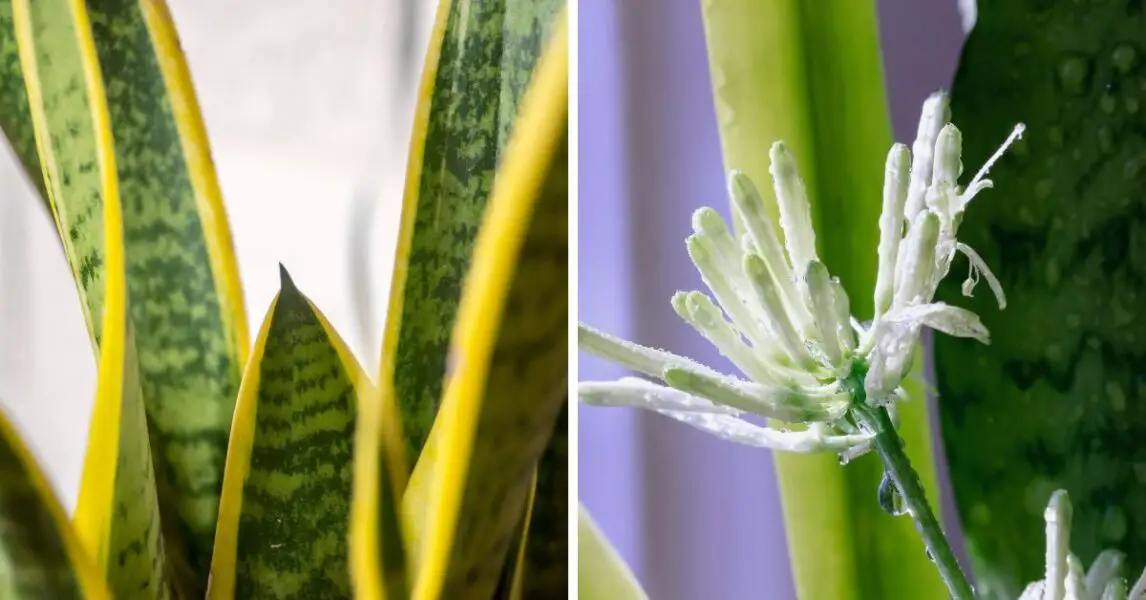
We surely know the popular mother-in-law’s tongue plant, also called St. George’s sword or tiger’s tongue, however scientifically it is identified as sansevieria.
Among other qualities that this attractive plant has, is that it is perfect for any corner of the home. In fact, we should not worry that it will die because it is a very resistant plant that survives poorly lit spaces.
In addition, through its leaves it purifies the air we breathe in our home, which is why many place it in bedrooms.
How to Make Mother-in-Law’s Tongue Plant Bloom
It is about providing a suitable environment for this popular plant to flourish, specifically it must be given its natural habitat. Let’s look at some factors that contribute to this:
Location and light:
The recommendation is always to place the plant near a window so that it receives the necessary lighting, so that its leaves can develop strong, healthy and its intense green color.
It is a slow-growing plant, it only creates three to four new leaves a year and when they grow they will be indicating if they need more light.
Mother-in-law’s tongue benefits
This plant called mother-in-law’s tongue is not only a beautiful plant to decorate, but it is one of the most recommended to purify the air in the home in the most natural way possible.
In fact, it eliminates toxins such as benzene, toluene, xylene and formaldehyde, precisely toxic substances that must be removed to breathe pure air.
Certainly its benefits are multiple for the whole family, among its properties, they act as a laxative and other components that help fight parasites, fungi and bacteria.
Therefore, among other medicinal qualities, it has components such as anthrachione, nepodine, emodin, tannins and proteins, etc.
Mother-in-law’s tongue plant care
We must follow some necessary care if we want to see them grow strong and healthy, let’s see what aspects to give them attention:
Watering
As we know, you have to take care of excessive watering that could rot the plant, you only have to do a measured watering when the soil or substrate is very dry.
Only in the winter season does it need water, once or twice a month.
Fertilizer
At the end of the spring season and at the beginning of summer, only once a month and until the temperature begins to drop in autumn.
To do this, we must use fertilizer to plant with flowers, because it will provide the essential nutrients to develop their flowers. They develop by the end of summer with their flowers that smell of vanilla.
Pruning
In pruning the tips cannot be cut because they will lose their shape, although it does not require pruning it may need to remove the dry leaves. In this way, diseases will be prevented from developing.
Transplantation
Keep in mind that if the pot is too small for our plant, it is best to change it to a larger container and at the beginning of spring.
One suggestion is to place some pebbles and pieces of mud at the bottom of the pot to make sure that it has good drainage, and at the same time does not become waterlogged.
How to reproduce the mother-in-law’s tongue plant
Reproducing it does not require much work, we can do it from a damaged leaf, since it will not recover its beauty:
- We can make cuttings with the leaf, with a scissors we cut the leaf into different pieces and then use it for reproduction.
- Then we proceed to reproduce the plant from the cuttings, for this we will need the rooting hormone.
- To apply this hormone, it will be enough for the piece to be covered a little.
- When we have the pieces ready, the next thing will be to place them on the ground. Without a doubt, we will achieve new plants.
Where to place the mother-in-law’s tongue plant
As we have already seen, we must place the mother-in-law’s tongue plant according to Feng Shui, in the home with the purpose of improving balance and harmony.
More precisely in the bedroom, because it is the place where we rest and relax, we can share this space with our plants without it harming our mood.
According to Feng Shui there are several very positive plants to have in the home, they give it that touch of color, relaxation and good health.