
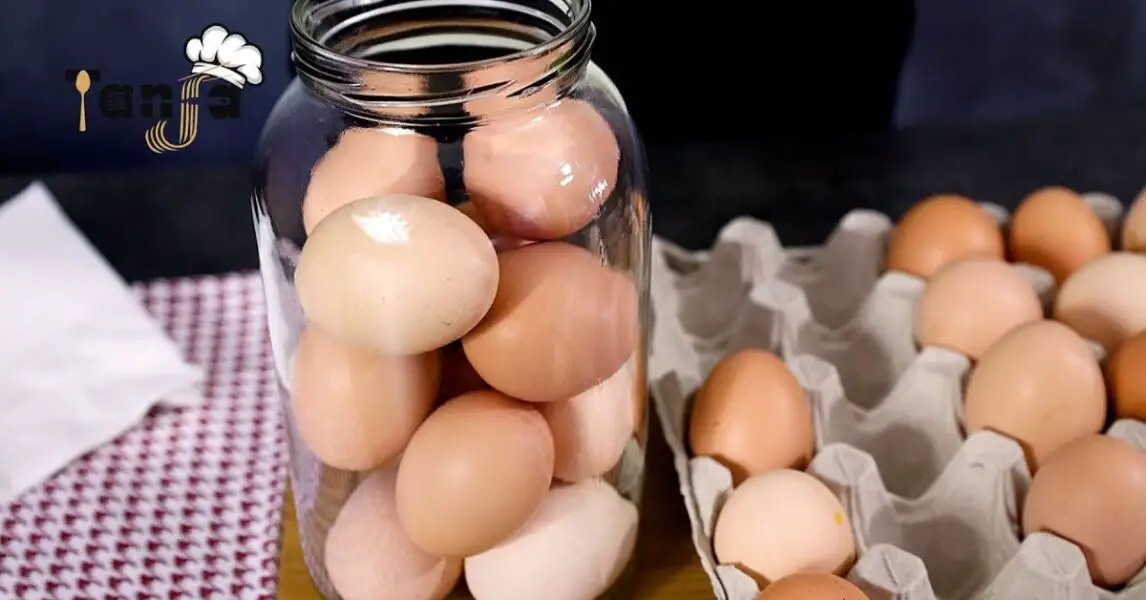
In the fascinating world of food preservation, we discover ingenious methods that have stood the test of time, and among them, the art of preserving eggs in jars is presented as a culinary gem.
This age-old method not only extends the shelf life of eggs, but also adds a touch of nostalgia to the kitchen. By following this process, we immerse ourselves in a practice that has been passed down from generation to generation.
Join us as we explore this method of preserving eggs, a journey that takes us beyond just storing food, but also immerses us in a culinary experience that connects us to the roots of home cooking.
Get ready to discover the art of preserving eggs in jars and enjoy their freshness for a long time!
Method for preserving eggs in jars and for a long time
First Recipe: Fresh Eggs Preserved in a Glass Jar:
- We need unwashed eggs. If the egg is dirty, clean it with a brush. A little dirt is not a problem.
- I carefully put the eggs in the jar. Be careful not to break them.
- Next step, you can use slaked lime powder. With only 2 tablespoons of slaked lime in 700 ml of water, mix it with a spoon and we have it ready.
- Slaked lime kills bacteria and fungi, so pour the mixture into the jar with the eggs and close well. The slaked lime will form a protective film around the eggshell. This way, the egg will be protected from decay.
- Once the bottle is sealed, it is stored in a dark and cool place until use. Over time the limescale will harden, but it will protect the eggs.
Eggs prepared this way can last up to 2 years!
Let’s look at another method:
Second Recipe: Boiled Eggs in Jars:
- In this recipe, 20 eggs will be cooked with a teaspoon of salt and enough water to cover them.
- When the water boils, it will be for approximately 12 minutes.
- While the eggs are cooking, grate 2 carrots and 1 beetroot, and chop 5 cloves of garlic.
- Sterilize the jars in the oven at 100 °C, for 30 minutes.
- When the eggs are finished cooking, they must be peeled and placed in the jars. Also, add peppercorns and garlic to the bottom of the jars.
- Then, 1 teaspoon of salt and 2 tablespoons of vinegar are added.
- We continue filling one jar with carrots and another with beetroot. The bottles have a volume of 750 ml.
- Fill them with hot water and clean the top of the jar so that the lid fits well.
- Prepare the jars for pasteurization.
- When the water boils, cook for 15 more minutes.
This method for preserving eggs for a long time is now complete!