
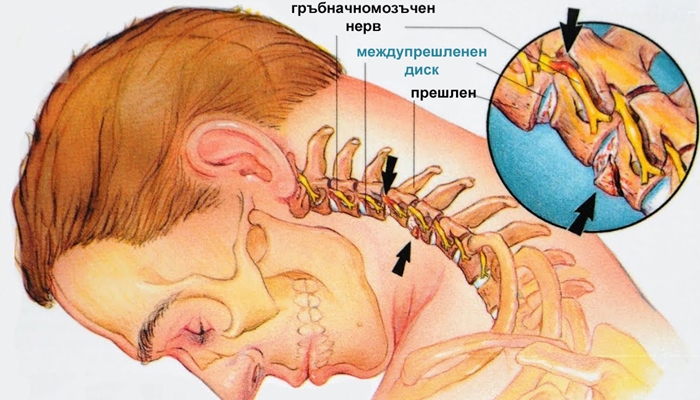
Osteochondrosis is a disease of the spine, in which changes occur in the cartilage of the intervertebral discs, and reactive processes develop in the tissues around them.
Here we will look at cervical osteochondrosis of the spine, which is distinguished from thoracic and sacral osteochondrosis.
Its symptoms are associated with the anatomical features of the cervical spine.
The size of the vertebrae in the cervical spine is smaller than in the vertebrae in other sections.
The cervical spine is constantly under stress, as it supports the head. It is distinguished by great mobility.
What are the causes of osteochondrosis
First of all, we can point out the age-related change in the body and the destruction of bone and cartilage tissues as the reason.
Apart from this main reason, there are a number of others, as follows:
posture violation
decrease in motor activity due to a sedentary lifestyle
excess weight, which is due to metabolic disorders – it loads the discs
hereditary factor
prolonged physical exertion
abnormalities in the spine.
Uniform physical activity, proper nutrition and a healthy lifestyle noticeably reduce the likelihood of developing osteochondrosis, as well as the impact on general self-esteem.
What are the symptoms of cervical osteochondrosis of the spine
The manifestations of this type of osteochondrosis are different from the symptoms in other parts of the spine.
This is due to the fact that the cervical vertebrae have a different structure and are located very close to each other.
Therefore, any displacement leads to severe pain and can cause pinching of a nerve.
Here are the symptoms of cervical osteochondrosis
Pain – it can be felt in different parts of the body. The pain is due to pinching of nerve endings and muscles in the corresponding part of the body.
Weakness in the upper limbs – it is due to pinching of nerve endings that determine motor activity.
Difficulty turning the head, crunching of the vertebrae in the cervical spine due to changes in the structure of the intervertebral discs and the appearance of bone formations.
Decreased sensitivity of the hands.
Weakness and dizziness due to pinching of the artery that provides blood supply and nutrition to the brain.
Deterioration of hearing and vision – this symptom appears in the last stage of the disease, when blood circulation in the cerebellum is reduced.
Signs of osteochondrosis of the cervical spine
Root syndrome – characterized by pinching of the spinal nerve in the cervical spine. It manifests itself through severe pain that can be felt in the shoulders and shoulder blades.
Spine syndrome – expressed in very severe headache attacks, pain in the temples and back of the head.
Reflex syndrome – manifests itself as severe pain in the cervical spine, which can be aggravated with each movement of the head. The pain shifts to the shoulder and chest area.
Cardinal syndrome – it is similar to an attack of angina pectoris, it is very difficult to determine.
Degrees of development of cervical osteochondrosis
This disease goes through several stages. Each of them has its own characteristics and characteristic features.
Stage 1: Degenerative disc alteration. The bone-cartilaginous tissue of the vertebrae gradually begins to break down.
The symptoms of this stage are difficult to notice. Very often, patients do not notice them, rather they associate fatigue and pain with fatigue and stress.
Stage 2: Disc protrusion. The discs begin to decrease in height, cracks appear on them. The patient experiences continuous pain, weakness, numbness of the face.
Stage 3: Herniated disc. Hernias begin to form in the discs, cervical blood vessels and muscles are damaged. The patient complains of dizziness, pain in the back of the head.
Stage 4: Osteophitus. The bone tissue that protects the vertebrae from unnecessary stress begins to grow, which leads to pinching of nerve endings. Stiffness of movements begins to appear, adjacent joints are damaged.
Dangers that are associated with cervical osteochondrosis
In the cervical spine there are a large number of nerves and arteries that supply the brain.
When their functioning is disrupted, the brain does not receive enough food to be able to function normally.
Such a situation can disrupt motor activity, cause pain in the limbs, as well as loss of coordination.
If no measures are taken, ischemia, stroke, as well as many other life-threatening diseases can develop.
Therefore, if any symptoms associated with this disease appear, it is advisable for the patient to consult a doctor.
Diagnostics of the cervical spine
The following types of diagnostics are used to study diseases of the spine:
X-ray – this is not an effective way to diagnose the disease
MRI (magnetic resonance imaging) – shows bone structures, formed disc herniations and their size
CT (computed tomography) – this method is less effective than MRI, as it is difficult to determine the size of hernias
Ultrasound duplex scanning – used when the general blood supply is impaired.
The study shows the existing speed of blood flow and whether there are barriers to this flow.
Treatment of cervical osteochondrosis
Treatment of cervical osteochondrosis should be carried out in a complex manner, depending on the situation.
A positive effect can be achieved with a complex and individual approach, which includes drug treatment, physiotherapy procedures, physiotherapy exercises, massage, and also folk medicine.
During a period of exacerbation, treatment aims to improve blood circulation and eliminate muscle spasms.
In such cases, drugs that improve blood flow, anti-inflammatory and painkillers and a complex of vitamins are prescribed.
Therapeutic exercise for cervical osteochondrosis
Therapeutic gymnastics gives visible results and is less dangerous at the stage of recovery.
Its principle of action is based on the restoration of blood flow in damaged parts of the body.
While performing the exercises, the patient should not feel discomfort and pain.
The set of exercises for the cervical spine is designed to strengthen the cervical muscles, and also as a prophylaxis.
Check out some of the best exercises you can do at home:
1. Point your chin down, bring it closer to your neck and slowly move your head first five times to the left, then five times to the right.
2. Now lift your chin and repeat the above exercise five times.
3. Tilt your head to the left, trying to touch your shoulder with your ear. Repeat five times on each side.
4. Straighten your chin and press the back of your head with your hands. Press the back of your head to your hands three times for 7 seconds.
5. Bend your head and tighten your neck muscles.
6. Repeat three times for 7 seconds.
7. Tighten the muscles of your neck and press your right temple with your right hand, and then the left with your left hand. Repeat three times for 7 seconds.
8. Straighten your head and, fighting the resistance of the tense neck muscles, press your chin towards the jugular fossa. Then raise your head, trying to keep your chin as high as possible.
Press it to your hands and hold it three times for 7 seconds.
While doing the exercises, do not try to hold your breath, breathe normally, calmly and smoothly.
If you feel pain, be sure to stop exercising and wait for it to pass. You will see that after the first few exercises you will feel much better.
Take care of your health, because at a time when almost all of us are bent down in front of computers all day, it is important not to forget to take care of our neck muscles, which are under daily stress.
Massage for cervical osteochondrosis
The purpose of the massage is to strengthen muscle tone and eliminate pain.
Depending on the stage of the disease, different massage methods are applied. Classic massage methods include:
stroking – consists in influencing the surface layer of the skin. It starts from the occipital area and continues to the collarbones and armpits.
Pumping – the massage affects the deeper layers of the skin. Transverse movements (widthwise) of the neck with the thumb and forefinger are performed, clamping on areas of the skin, similar to the movement when squeezing.
Rubbing – has special limitations, as it affects the tissues located deeply. If performed incorrectly, the patient can be harmed.
In such cases, when the patient experiences a feeling of pain on only one side, the massage should start from the healthy side, gradually shifting to the part of the neck where the pain is felt.
Safe neck traction at home to relieve pinched nerve
And here’s a great technique you can use at home or in the office to help reduce pain in the neck and down the arm from a pinched nerve.

Only with the help of a terry towel can you expand the intervertebral spaces through traction (pulling) and thus release a possibly pinched nerve.
Post-isometric relaxation
Thanks to the post-isometric relaxation of the neck, a relaxing effect is achieved on those muscles that are difficult to influence during massage.
This is a unique technique that can relieve muscle spasm, improve blood circulation, and hence reduce the tension on the spinal nerves.

Because of the results achieved, some even say that this is a special soft manual therapy technique, but without any health risk.
Prevention of the occurrence of cervical osteochondrosis
To prevent the occurrence and development of the disease, it is recommended to follow a few simple rules:
You should lead a healthy life, with exercise, and regularly visit the pool
to diversify the diet with products rich in magnesium and calcium
With a sedentary lifestyle, movement should be performed several times a day
The bed should have an orthopedic mattress and a comfortable pillow.Facebook group for mutual help – WE HELP everyone with tried and tested folk recipes here –
If you liked the article and useful tips from our online health portal, you can follow us and share them with your friends, as well as your opinion (or experience) in the comments!