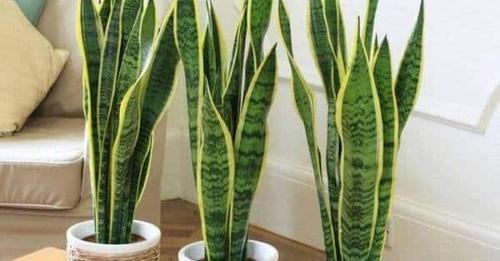
Sansevieria may be nicknamed “mother-in-law’s tongue”, but it nonetheless remains an excellent company plant. Some species produce a sap which was formerly used as an antiseptic, the leaves being applied to the skin like a bandage. The Mayans used it to make hammocks by working their fibers. Beyond these uses, we love it for its aesthetics and its easy-to-maintain nature! It is a companion that will adapt to any environment. Are you won over by this tropical beauty? So, read on to learn more about Sansevieria, its care and essential needs!
1 – THE DIVERSITY OF SANSEVIERIA
The most common mother-in-law’s tongue is the dark green form (Sansevieria trifasciata). Its variegated form (‘Laurentii’) is brighter, with its leaves edged in light yellow. There is a dwarf form, ‘Golden Hahnii’, with rosettes that are wider than they are tall. You will also find the very beautiful sansevieria with cylindrical leaves (S. cylindrica), often sold braided: it never keeps the shape we give it and always takes on a more natural fan shape. This species of sansevieria is also sold with the tips of the leaves painted, a somewhat decorative version but which eventually fades. Finally, there are other sansevierias such as the spotted-leaved sansevieria (S. masoniana). Its leaves are wider and it grows more slowly, but it is a real camel plant for indoors (by camel plant, mean that it resists lack of water)
2 – HOW TO GROW IT?
Having a plant in your home that can purify the air you breathe is of great value in improving the quality of your life at home. This is particularly true for Sansevieria, even included by NASA in the list of best purifying plants, a function carried out by absorbing pollutants and at the same time releasing oxygen.
But how to keep it in the best possible way, then? First of all, keep in mind that as soon as you buy it you will have to move it to a larger pot and that, as I expected, we are talking about a plant that needs a lot of light and which struggles to survive below 3°C, on the contrary resisting high temperatures quite well.
3 – WATERING
Water about once every two weeks, or when the surface soil is completely dry. To make sure you don’t overwater, you can simply mist the surface of the soil.
4 – WHERE DO YOU PLACE YOUR SANSEVIERIA IN YOUR INTERIOR?
Due to its origins, it likes heat and needs a lot of light to flourish. But avoid placing it in direct sunlight which risks burning its leaves.
A stable ambient temperature around 20°C is ideal. Be careful, below 13°C, your Sansevieria risks catching a cold and not recovering…
5 – DISEASES, PESTS AND PARASITES
Sansevieria is very resistant. However, it can be subject to attacks by mealybugs. In this case, use a cloth soaked in methylated spirits, beer or soapy water. Then rinse with clean water.
Be careful not to give it too much humidity which will cause the roots and then the leaves to rot.
If its leaves turn pale and lose their stripes, it is surely due to a lack of light or a nutritional deficiency. Place the sansevieria in a more suitable location and add suitable fertilizer.
6 – POTTING THE SANSEVIERIA
The sansevieria needs to be repotted only when the roots are cramped in its pot, approximately every 3 or 4 years. We then select a pot barely larger than the previous one and which has a hole in the bottom to allow the water to drain.